Free resource
How to Write a Good CV
An extensive guide to build a standout CV in 2026. Learn how to build a CV that gets interviews.
Who This Guide Is For
This guide is for:
- People applying for competitive roles
- Career changers trying to reposition themselves
- Graduates entering a crowded market
- Anyone sending applications and not hearing back
If your CV isn't getting interviews, it's not working. And you likely have the skills. But in this market, average doesn't survive.
The Job Market Has Changed
2025 was one of the toughest years I have ever seen for hiring.
Many roles now attract hundreds of applicants. Some attract thousands.
AI is a great tool but often makes generic, unauthentic CVs.
If your CV is average, you are not "almost shortlisted." You are filtered out.
- Good formatting is not enough.
- Being hardworking is not enough.
- Having experience is not enough.
Your CV has to be strategic, solid and standout.
Your CV Now Has to Work for Three Readers
- Screening software (ATS systems)
- AI filtering tools (e.g. someone using Claude AI to screen)
- A human recruiter or hiring manager
That means your CV must:
- Contain the right keywords
- Show real evidence and talk to real situations, not vague claims
- Be structured clearly
- Avoid generic AI style waffle
- Feel authentic and human
- Be able to speak to a range of people in the company you are applying to
That's a difficult brief. Most people don't know how to do that. This guide will show you how.
What a CV Is Actually For
A CV is not a biography. It is not a record of everything you have ever done. It is not a place to prove you are hardworking, motivated, or passionate.
A CV is a marketing document designed to get you an interview.
That is its only job. Not to get you hired. Not to tell your life story. Not to show how nice you are. Its job is to move you from: Unknown applicant to Worth speaking to.
What Most People Think a CV Is For
Most people think a CV should list every job, include every responsibility, show how loyal and hardworking they are, sound formal, and avoid standing out. So they write "I am a motivated and hardworking individual…", "Dedicated individual with attention to detail", "Team player with good communication skills" — and then wonder why nothing happens.
What a Strong CV Actually Does
- It shows direction. It is clear what role the person wants.
- It shows evidence. It proves skills through outcomes and strong story telling.
- It is easy to scan. A reader can understand the person's value in under a minute.
The Big Shift You Need to Make
Instead of asking "What have I done?" you need to ask: "What role do I want next, and how do I position what I've done to support that?" That one shift changes your profile, skills section, work experience, project descriptions, and the order of your CV.
What Your CV Must Do in 10 Seconds
Your CV gets roughly 10 seconds to make a first impression. In that window it needs to pass four tests:
- Show fit — target role visible immediately; relevant hard skills/tech stack listed; location and right to work stated; clean, working links (LinkedIn, portfolio, GitHub).
- Prove value — skills backed by evidence and outcomes, not just listed.
- Be easy to scan — 1–2 pages max; clear headings and consistent structure; Month + Year dates.
- Be specific — mirror keywords from the job ad/organisation; tailored per application.
KEY PRINCIPLE
How Recruiters Triage a CV
- Stage 1: Scan (under 10 seconds) — eyes land on the top third of page one, looking for role fit, keywords, clear structure. If none register, the CV is set aside.
- Stage 2: Skim (about 60 seconds) — if the scan passes, they read skills, experience bullets, project detail, dates, building a picture of what you can do.
- Stage 3: Decision — shortlist, maybe pile, or reject. Rarely a second chance.
Pro tip
ATS-Ready Checklist
Before your CV reaches a human it usually passes through an Applicant Tracking System (ATS). If your formatting confuses the software, your content never gets seen.
- Single column layout with standard headings (Profile, Skills, Experience, Projects, Education)
- No tables, text boxes, icons, or images of text
- Contact info in the main body at the top, not in headers or footers
- Clear role titles. Month + Year date format for all roles and education
- Include keywords from the job ad/organisation throughout
- Active links, and confirm every link actually opens
- Save as PDF by default, but keep a clean DOCX version ready
- File size under 1MB
- File named clearly:
FirstName_LastName_CV_TargetRole.pdf
KEY PRINCIPLE
The Before and After Example
A real example: a typical CV that's not terrible, not messy, not full of mistakes — but not strategic.
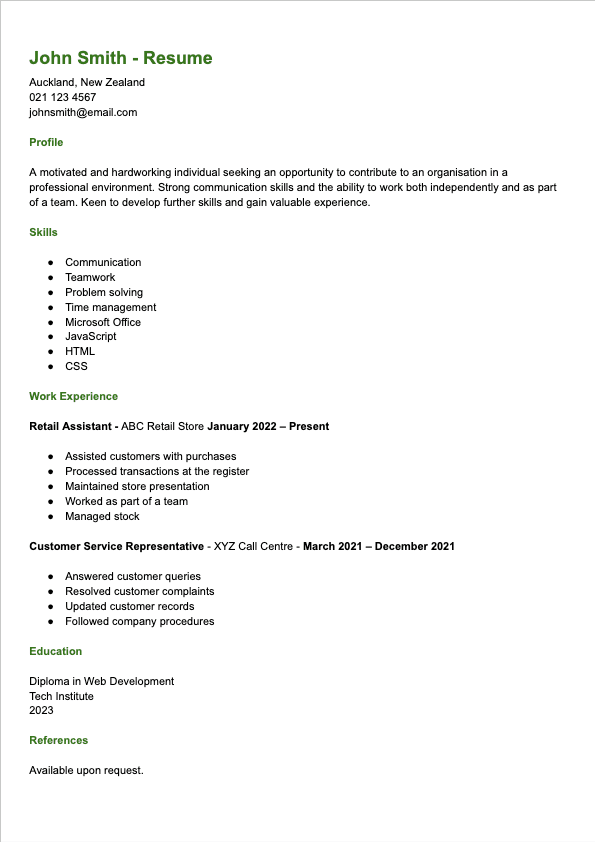
THE GENERIC CV
Most generic CVs are not terrible. They are just forgettable. And forgettable does not get interviews.
Now the same CV after ~30 minutes of work:
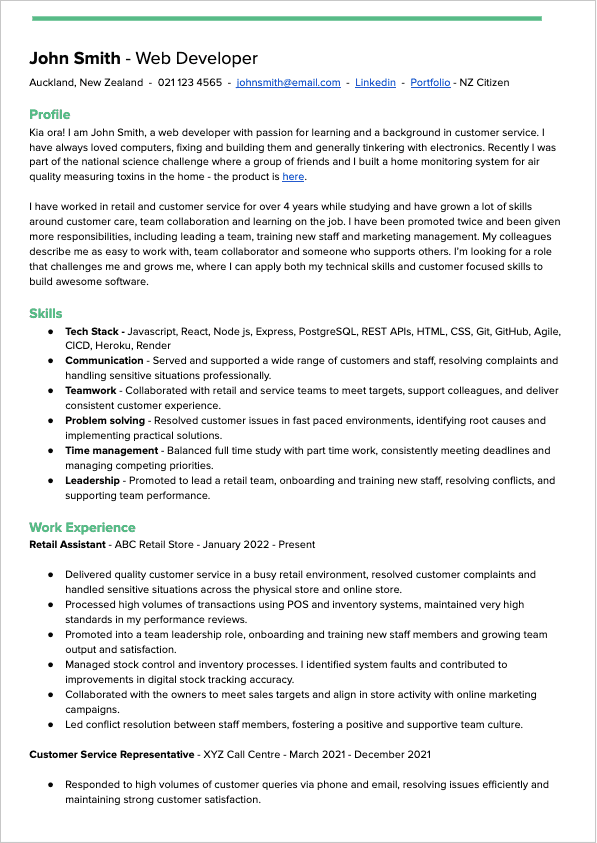
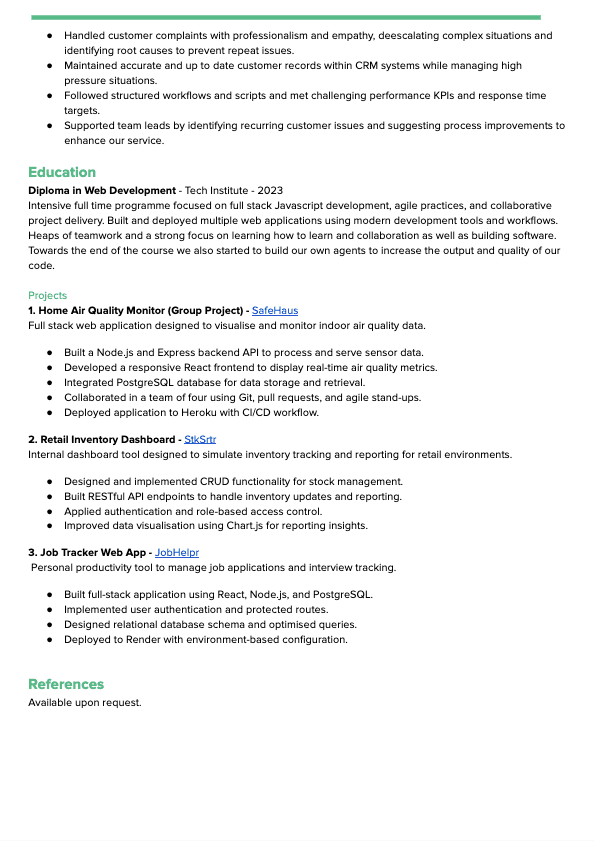
THE STRATEGIC CV
The person did not change. The experience did not change. The positioning changed, the clarity improved, the evidence strengthened — and suddenly the candidate feels more capable.
Breaking Down the CV
Six numbered sections, each with a BEFORE (generic) / AFTER (strategic)image pair, an "ASK YOURSELF" or explanation, and a "KEY PRINCIPLE" callout.
Section 1: Title and Contact Information
The title section is the first thing a recruiter sees and quietly answers: who are you, what role are you targeting, can I contact you easily, are you credible, are you eligible to work?


- Before (generic): just a person, a phone number, an email.
- After (strategic): states the role clearly, removes ambiguity about work eligibility, provides live links to verify experience.
- Why it matters:"John Smith – Resume" gives nothing to anchor to; "John Smith – Web Developer" categorises you instantly. Live links create credibility in a market full of AI-generated CVs.
CV Header Checklist(top third of page one, single column): full name (prominent); target role directly below name; City + NZ (no full street address); right to work (e.g. "NZ Citizen" / "NZ Permanent Resident"); email and phone; LinkedIn, portfolio, and/or GitHub; no photo, no date of birth.
KEY PRINCIPLE
Section 2: The Profile
The profile (or summary) sits at the top, usually 5–12 lines — and it's the most wasted space on most CVs, because people describe their personality instead of their value.


The formula for a strong profile: who you are (target role); your core technical capability/skills; relevant background that supports the role; the kind of contribution you want to make.
Optional additions: something you're working on/learning; how others describe you (acts like a reference); a big accomplishment supporting the role; something you love about their organisation.
Avoid: "Motivated and hardworking individual"; "Seeking an opportunity"; generic soft skills with no evidence; third person; long autobiographical paragraphs.
KEY PRINCIPLE
Section 3: The Skills Section
Where many CVs quietly collapse — most people treat it like a shopping list.
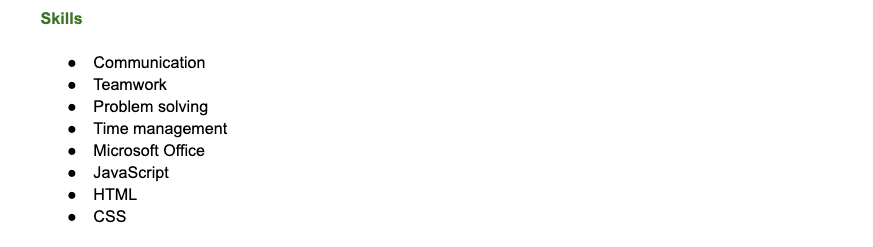

Group skills into tiers (total 12–18):
- Core (confident and proven): JavaScript, React, Node.js, Express, PostgreSQL, Git
- Familiar (used in projects/study): TypeScript, REST APIs, CI/CD, Docker, Agile
- Learning next (actively developing): AWS, GraphQL, Kubernetes
Add one-line proof for key skills, e.g. "Communication – Resolved customer and staff issues across retail and service environments"; "Leadership – Promoted to team lead, onboarding and training new staff".
KEY PRINCIPLE
Section 4: Turning Duties into Impact
Most CVs list what you were responsible for; recruiters want to know what changed because you were there.
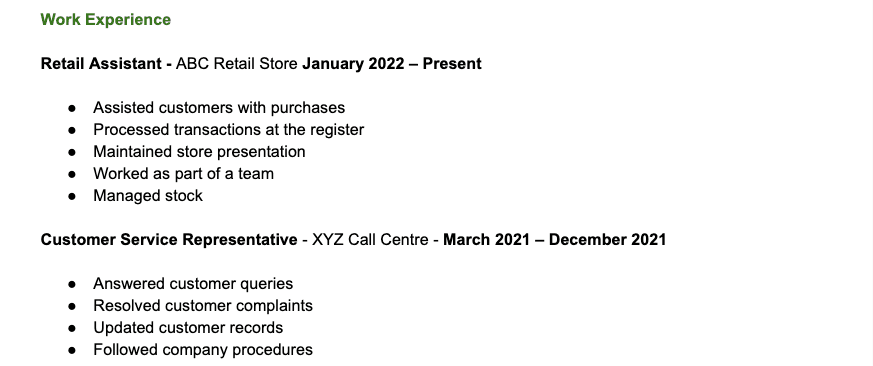
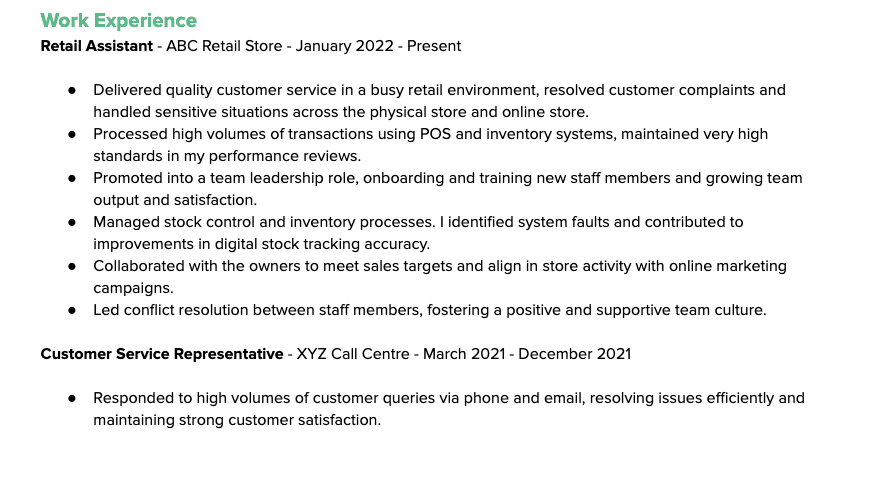
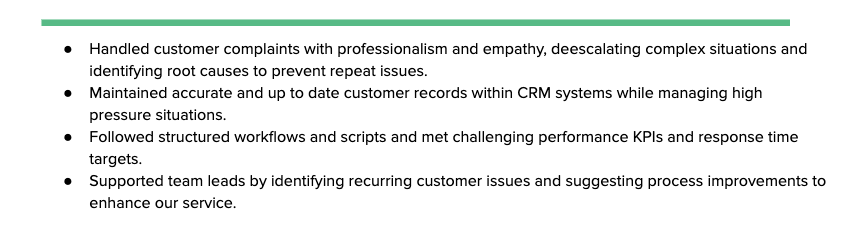
The simple rule: Action + Context + Impact.e.g. "Led onboarding of three new team members, reducing training time by 20%." You don't need huge numbers — you need evidence of effect.
The 3-bullet pattern per role: what you built/delivered and for whom; the hardest thing you solved; the outcome with a number. Include tech keywords inside bullets so ATS systems find them.
Use "Experience"not "Work Experience" so volunteering, freelance, and side projects fit. Explain gaps >6 months in one neutral line; compress older/less relevant roles to a single line.
KEY PRINCIPLE
Section 5: Education and Projects
Education matters, but not always how people think. For early-career candidates it carries weight; for experienced candidates it's background context. For graduates and career changers, projects are proof— "I built" beats "I studied".

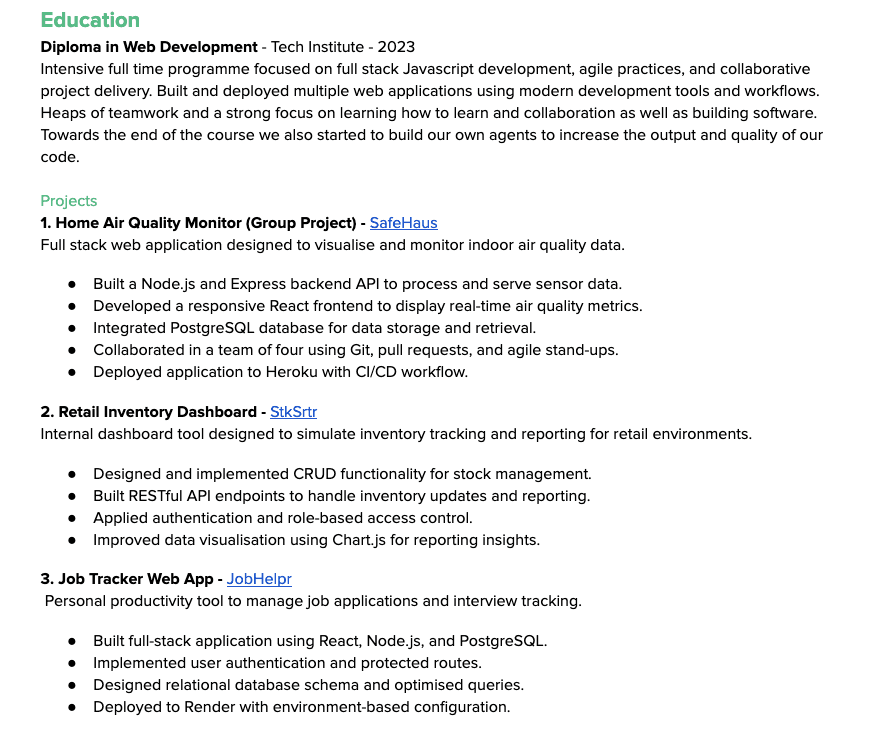
- Expand education when: recent graduate; changing careers; highly relevant qualification; lacking professional experience.
- Minimise education when: 5+ years relevant experience; unrelated degree; track record matters more.
Project entry template:
Avoid vague phrases like "Worked on", "Helped with", "Was part of".
KEY PRINCIPLE
Section 6: Final Check
- Consistency check: dates formatted the same way; job titles consistent; bullets aligned; punctuation consistent; no spelling/grammar errors.
- File format and naming: send as PDF unless told otherwise; name clearly (
FirstName_LastName_CV_WebDeveloper.pdf); avoidCV_Final,Resume_Updated,NewCV2. - Live links check: LinkedIn / Portfolio / GitHub work, are up to date, match your CV.
- The final test — if you were one of 300 applicants: Would this stand out? Is it clear what role I want? Does it show proof? Is it easy to scan? Does it feel intentional?
Want to know if your CV is going to work out there — book a free call and find out.